
Artist Focus: Harrison Sayed
Your recently released noContainer EP was a capstone senior project for the Electronic Production and Design program at Berklee College of Music, it was also composed entirely with Max and released in the form of Max patches on GitHub. Could you talk about this choice and how the project fits into your work at Berklee?
My decision to compose noContainer procedurally stems from my musical roots. Before approaching electronic music, I was heavily involved in various forms of jazz. In the later years of this musical development, I was listening to and adopting forms from John Coltraneʼs later works, Miles Davisʼ electric period, and other musicians who worked within a more ‘freeʼ context.
Naturally, I inherited a joy for improvisation. This leaves me often in a musical position, where I never want to hear the same thing the same way twice. Procedural audio leaves a lovely amount of room for this.
I began to upload my work to GitHub for several reasons; both practical and somewhat political in intention. The ability to make commits, and store updated versions of a collection of files allows one to publicly document the progression of a work. GitHub is also a beautiful way to ‘backupʼ relevant data. A dead hard drive would have been depressing, midst composing an EP.
Why did you choose to make this project procedurally? What do you think about the current state of procedural audio in music?
noContainerʼs presence on GitHub was an attempt to look towards an alternative medium for music. Personally, I have no interest in selling my music. Standard forms of musical copyright, in a traditional sense, feel antiquated and unnecessary. They attempt to contain musical form to solely harmony and melody. noContainer has most of its musical development on larger timescales. The prospect of having an EP (in this case synonymous with computer program) open source allows one to freely share it with the public, and potentially protect it under creative commons.
Music and software are at a quirky intersection. The software community is very open, and continues to release free public libraries. This builds a healthy forward motion, where the whole can build upon newly shared ideas from individuals. The “music industry” has historically existed in antithesis; attempting to contract everything into secrecy and privacy. The music in this case, is leashed and capitalized on. It can never actualize in such a way that an indeterminate entity might.
What would your live setup look like for this kind of project, and how do you think about Max differently in the studio compared to playing live?
I actually began to compose noContainer as a means to learn more about how I could include procedural elements in live performance. Up until then, I had been using a fairly empty set in Ableton; constructed of defaulted, stock instruments with various Max for Live devices. I would then compose everything in front of the audience, utilizing a cueing system to hold a musical juggling act. This approach was fun and a good exercise in simple, quick thinking, but one needs to be able to take this large macro, that is the musicʼs current vibe, and move it instantly.
Procedural audio allows one more mobility. Macro controls allow a structuring of elements. Previous musical decisions can be captured, and used as new ‘seedsʼ. The use of feedback between macro controls and their lower level components together, as another control and musical device, becomes present.
For example, on a smaller musical timescale, one can weight metric ratios against the current position within a musical bar, and then weight that again against sampled waveforms. Here is an early example in gen~:
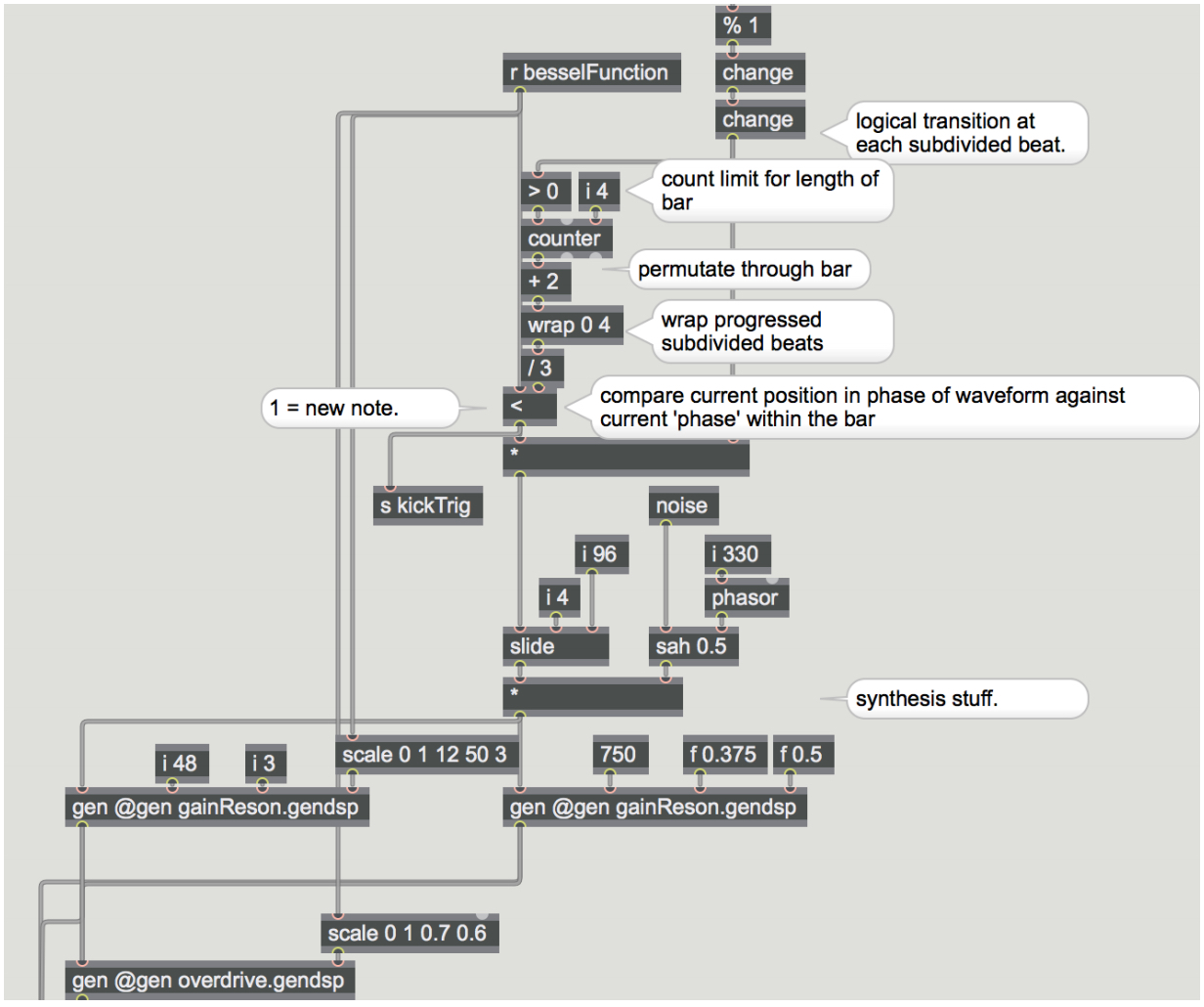
On a larger timescale above this, one could implement macro controls, such as ‘densityʼ and ‘indeterminacyʼ. Given a coefficient between 0 and 1, ‘densityʼ could be scaled accordingly to multiply the weight of the bar against the sampled waveform. When the weight of the bar is 0, all logical transitions would become ‘notesʼ. Also given a coefficient between 0 and 1, and then scaled accordingly, ‘indeterminacyʼ could scale the index and feedback amounts of an fm synth generating the waveform. When the waveform does not repeat in this context, one essentially arrives at predictable noise.
The difference between my work in a live context, and that which is in a studio context, is that in a ‘studioʼ all the values controlling the piece are hard-plugged and finite. In a live context, I need to move the music quickly. Algebraic expressions become a necessary tool so that the output is predictably variable.
You also have experience using Max for VJing, how do you compare performing live with video vs audio and how does your live setup change?
My work with using Max to VJ, sat mainly in the context of DJ support. I relied on the manipulation of filmed material, in order to create a dynamic visual experience for the audience. This heavily contrasts my procedural work with audio in Max, which relies on pure synthesis.
Noise and compression were the charms I enjoyed in my visual work. In procedural audio, one works with 64 bits of floating-point dynamic range. You can squish the audio to a pulp with compression, and thereʼs no shift in tonality. The noise floor is so far down it can be ignored.
In terms of tools or controllers, I spent a lot of time using the monome arc; progressing from a glorified video mixer to more of a macro controller with LFOʼs.
Stretta (Matthew Davidson), has a great library of BEAP and m4l devices on GitHub right now, which include some of the arc abstractions I had used for LED feedback.
For my live music performances Iʼve spent a fair amount of time incorporating a combination of Ableton, Eurorack, and m4l devices. None of it has been truly generative or procedural to date. Iʼm primarily looking to reverse this situation.
How do you play with this interesting audio/visual contrast and different live tools? What kind of impact do you think this has on your relationship with the audience and their overall perception of your improvised performances?
Although Iʼve experimented with intermedia work in the past, Iʼm currently in a position where I prefer to see my audio and visual work separate. We live in a very ocular-centric culture, in that a lot of experiences are confirmed visually before they are heard. This is rather evident with many main stage events that have heavily contrived visual productions, while utilizing pre-recorded audio for performance.
In an ideal situation, I would prefer a pitch-black room; that or that the audience would feel the cultural need to close their eyes, and simply ‘seeʼ with their ears.
Iʼm not concerned with the tools the performer is using. It could technically be a stick hitting a can. If the sound coming out the loudspeaker sounds good, and moves the audience, physically or emotionally, itʼs appearance is superfluous.
All this being said, Iʼm a big fan of silent film.
What can listeners expect from your future compositions, and where can they go to keep up with your work?
All of my procedural works are present on my GitHub. I like to make commits, whilst working on them. There can be no real ‘endʼ or ‘finishʼ to a procedural piece.
I also have other compositions, some procedural, some through-composed on my website harrisonsayed.com .
In the future, I look forward to compiling code, and embedding it into html. This would allow the music to generate, and actualize on the listenerʼs computer. I love the prospect of having my music free on the most accessible platform, whilst not being subject to the current standards of compression.
by Zeos Greene on October 17, 2017
