
Bug: Message box keeps the backslash in \$13, \$24 and \$25 but not \$10 or \$100

Hello!
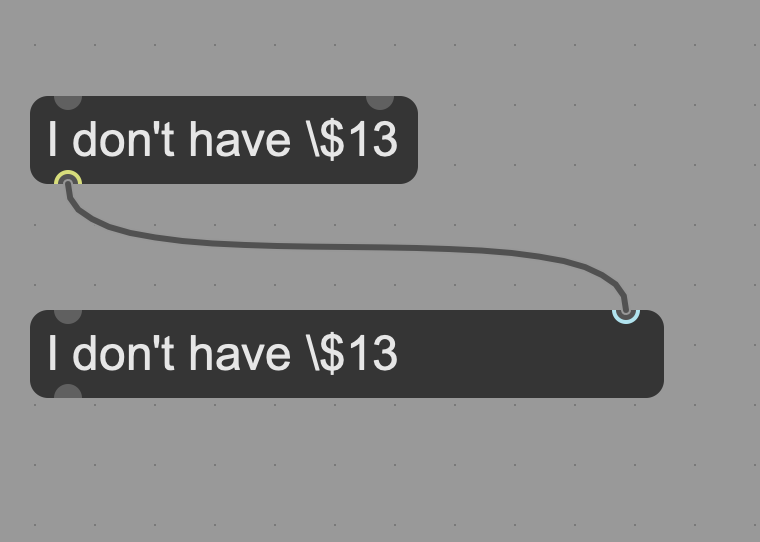
I'm learning Max and have been playing around with the message box and following the user guide. I noticed that \$13 should output a $13 but the backslash comes through too. I put "I don't have \$13" in a message box and connected its outlet to the right inlet of a second message box. After I clicked the first box, the second showed "I don't have \$13". \$24 and \$25 do the same. \$10 and \$100 show "I don't have $10" and "I don't have $100" as expected.
I haven't tested many numbers but maybe there's a pattern! Screenshot below.
This is using Max 9.2.1

HI. There is no bug. It is working as intended
Try typing [I dont have $13] without the \ .
Also, check the print window
10, 100 are the same as tosymbol
I you want 13 you can use sprint or pak
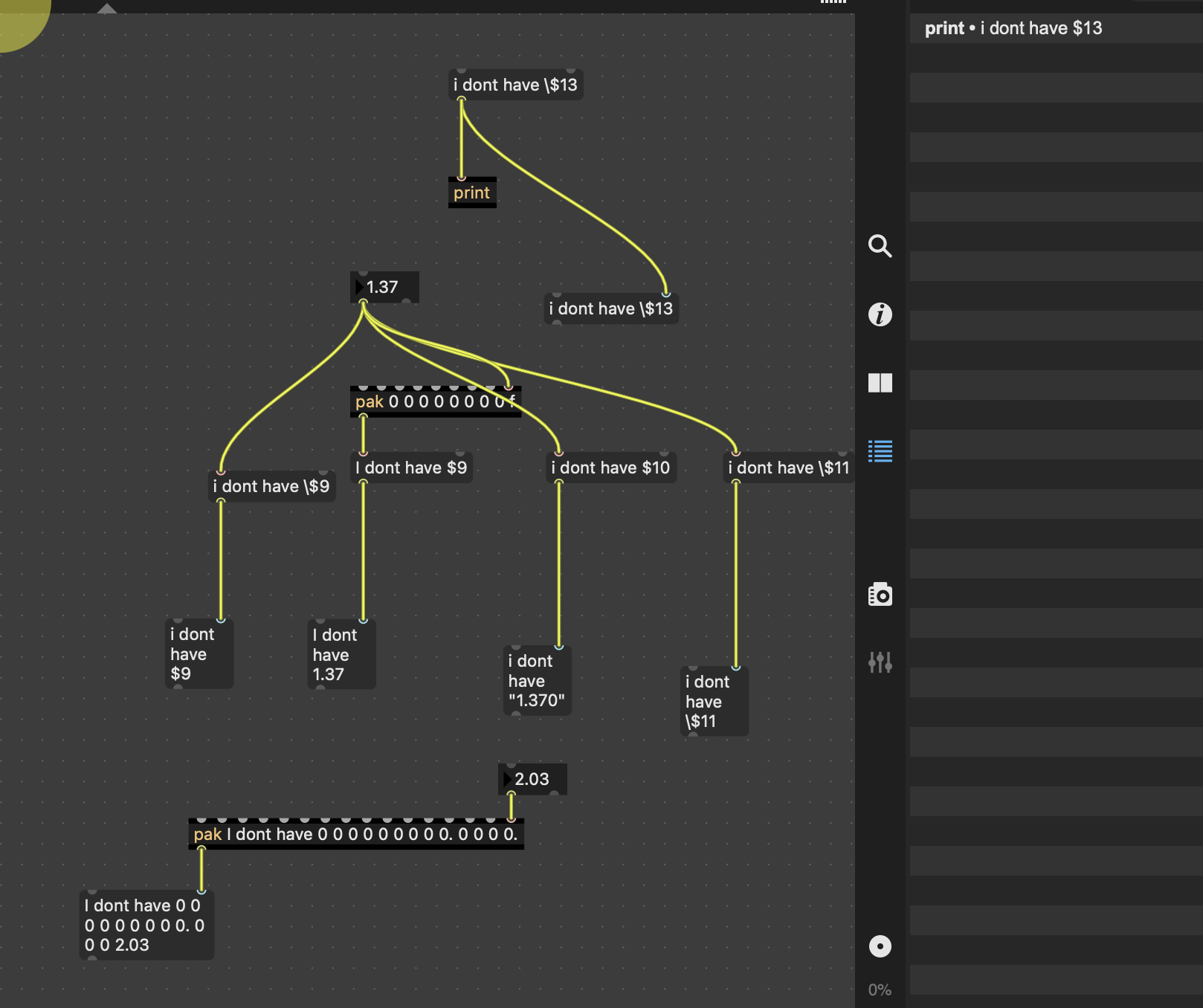

It's a funny one. As stated in the documentation, the $ notation to get a specific item from a list into a message only works with up to the 9th element. So $1 up to $9 . So anything above $9 should be treated as actual symbol and not a reference to an item in the incoming list. This is what happens when you type `I don't have $13` in a message box, which gets automatically transformed to `I don't have \$13`, the backslash escaping the dollar sign.
I think there is actually a bug in the auto-escaping mechanism from the message object, which will also accept $1 up to $9 followed by anything starting with 0. Which is why $10, $100, $90 or $20Y8 doesn't get escaped, but $11 $120 $91 or $21Y8 does.
If you send a b c d e f g h i j k into a the tenth letter is $10 you will get the tenth letter is a0 which matches the behavior described in the doc: $1 gets changed to the corresponding item in the list, and what follows (the 0) gets stuck to it. I assume that in this case, the tenth letter is $10 should be automatically transformed to the tenth letter is \$10 after validating. Or keeping it as is, but then $13 shouldn't be escaped either and should give a3 in this case.
I will report this to C74.
Anyway, for message formatting, especially when dealing with Max-specific symbols like $ , I would prefer using [sprintf] for formatting, and [comment] to display:

that is what happens when you use regex to find strings in your compiled objects. :)
but... is it really unintended?
mind you, it can be legit to have #0 - #9 followed by something else than a space character. it always was possible to write #0_foo or #1mycustomname somewhere (and imho it is a nice feature.)
now why would you disallow the user to write #1001? why (or better: how) should max make the decision here what is meant by the user? he could as well want the #1 to resolve as patcherarg.