
OPTINA PUSTYN — a geometric, generative sampler for Max 9
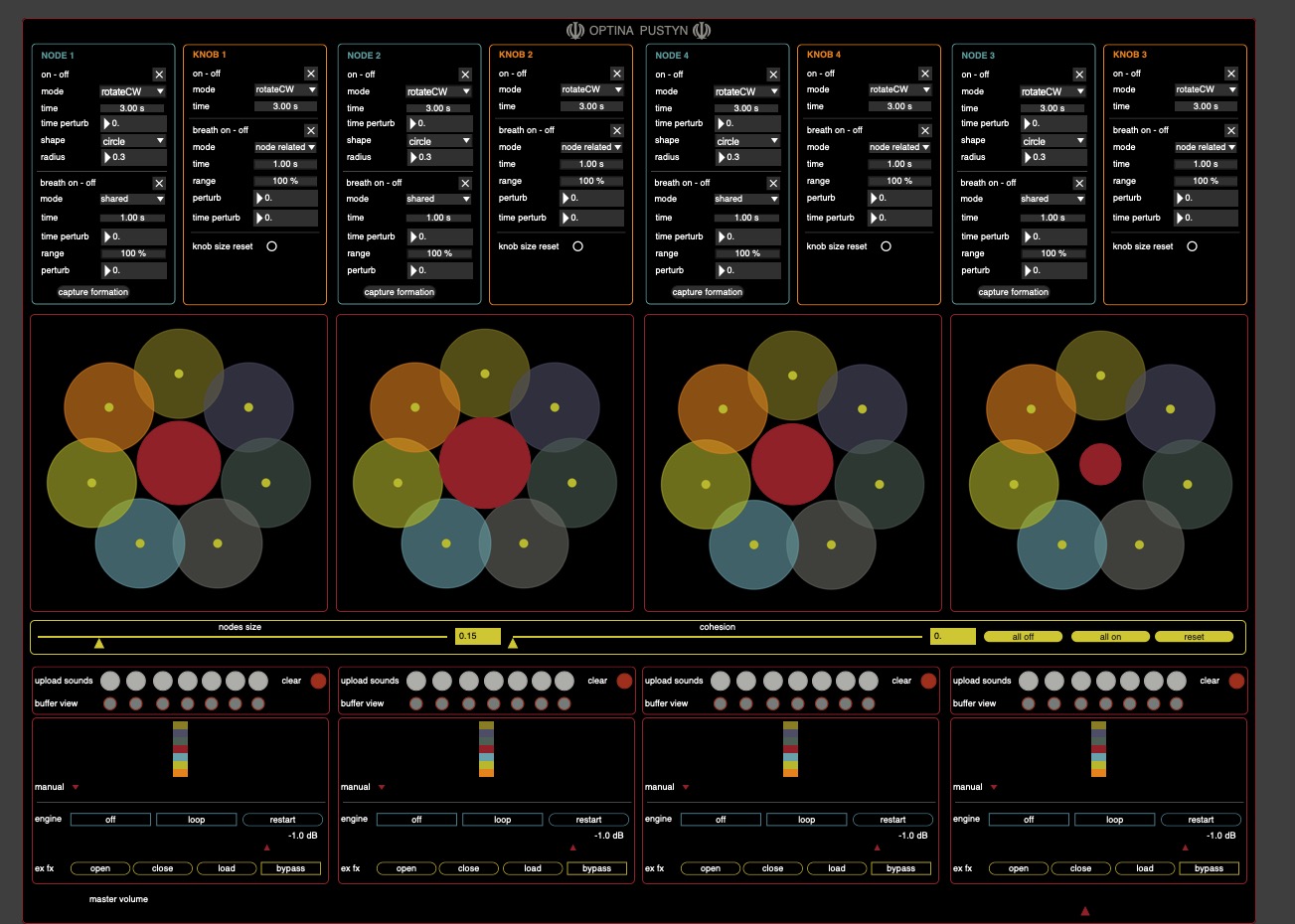
OPTINA PUSTYN is a Max 9 instrument in which four autonomous agents move through geometry and play 28 audio files: a roaming knob touches a node, and that node's sound fades in.
The idea
The sound is not sequenced, it is placed. Seven nodes sit on a plane, each holding one audio file. A knob drifts across the plane; when it covers a node, that file fades in, and it fades out when the knob leaves.
Two things shape what you hear: where the knob goes, and how large the nodes and the knob are. A bigger knob covers several nodes at once and layers their files. Both position and size are animated by autonomous motion modes, so a patch can evolve for a long time with no hands on it.
The same logic runs four times in parallel, one agent per column. A single cohesion control can pull all four toward the first agent, from complete independence to near-unison.
The instrument
The interface has four columns, one per agent, in three horizontal bands.
Top band: control panels. Each agent has a NODE panel (movement of the seven nodes) and a KNOB panel (movement of the knob). A general-commands block sits in the top-left corner.
Middle band: four nodes displays. Each shows seven coloured nodes and the red knob moving in real time.
Bottom band: four audio engines. Per column: sample upload, waveform view, pan, external FX, gain and meter.
A yellow bar at the bottom holds the global controls: node size, cohesion, reset, all on, all off and master volume.
Each agent owns seven audio files, so the instrument loads 28 files in total. Every file is assigned to one node, with one upload button and one waveform view per node.
Controls
NODE panel (per agent)
On / off starts or stops the agent.
Mode picks one of 12 motion modes (see the next section).
Time (100–30000 ms) sets the length of one cycle; time perturb (0–1) desynchronises the seven nodes from each other.
Shape and radius place the nodes in a geometric formation: circle, horizontal line, vertical line, spiral, cross, grid, Lorenz attractor or Clifford attractor. The last two are chaotic systems sampled at seven points. Radius goes from 0 to 0.45.
Capture formation lets you drag the nodes into any arrangement by hand and adopt it as the starting formation.
Breath animates the size of the seven nodes. It has a shared or random mode, a time, a range (0–100%, from fixed to full excursion), a perturb amount and a time perturb.
KNOB panel (per agent)
On / off, mode (rotate clockwise, rotate counter-clockwise, rotate mix, random, elastic, bounce), time and perturb drive the knob's path.
Breath animates the knob's size, either related to the node sizes or random, with its own time, range and time perturb. A reset button returns the size to its default.
Knob size matters musically: a large knob covers more nodes and triggers more files at once.
Global controls
Node size sets the size of every node on all four agents.
Cohesion (0–1) blends the output of agents 2, 3 and 4 toward agent 1. At 0 they are independent; at 1 their nodes, knob and sizes match agent 1. Internal states stay independent, so lowering cohesion lets each agent resume its own path.
Reset, all on, all off stop everything, start everything, or return all nodes to the centre and clear every mode.
Movement modes
The seven nodes can move independently or as one rigid body. Each mode below exists in both forms; the group version is labelled _fixed in the menu.
