
Question about MSP tutorial "Waveshaping"

Hey all!
I am making my way through the MSP tutorials in the reference... is there anybody who could explain to me, why the input signal for the lookup~ object is scaled by 0.99? It is not explained in the tutorial.
Any tips and help much appreciated, thanks!
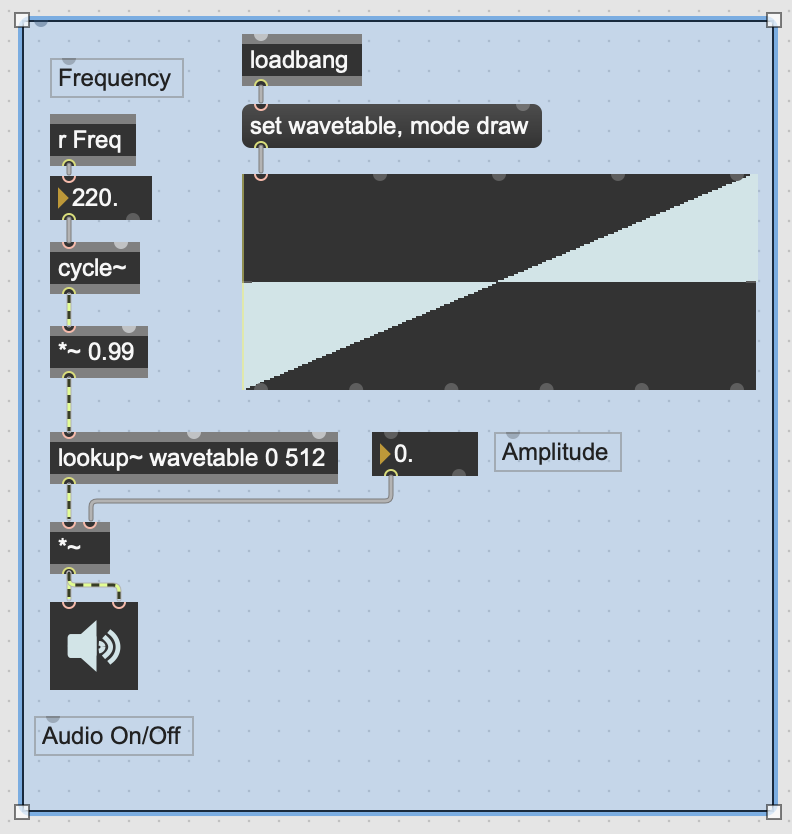

That's a fair question : I overlooked this point when studying the tutorial recently...... as far as I understand, [lookup~] is supposed to do nothing here, since the transfer function is y=x. Scaling x by 0.99 only brackets y by the same factor ? Is it a rounding issue ? Indeed, played as is, you only get a 220 Hz peak. But changing 0.99 to 1. adds waves of partials....
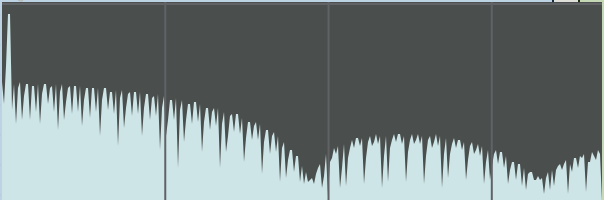
Thanks ! Just trying to understand a bit better :
lookup~ treats '1' and '0' as the same address, so you do this to avoid repeated values...do you mean that when x reaches 1, [lookup~] outputs the same value as for x=0 (0, in this case) ?
lookup~ is meant for use ideally with phasor~even if [lookup~] accepts negative values ?
No worries at all, R∆J∆.
I'll need more time to review the material you just posted, but many thanks already for providing it.

Thanks for all your answers! I also figured out that it works perfectly, when the buffer is 1 time bigger than it is read from, does that make sense?
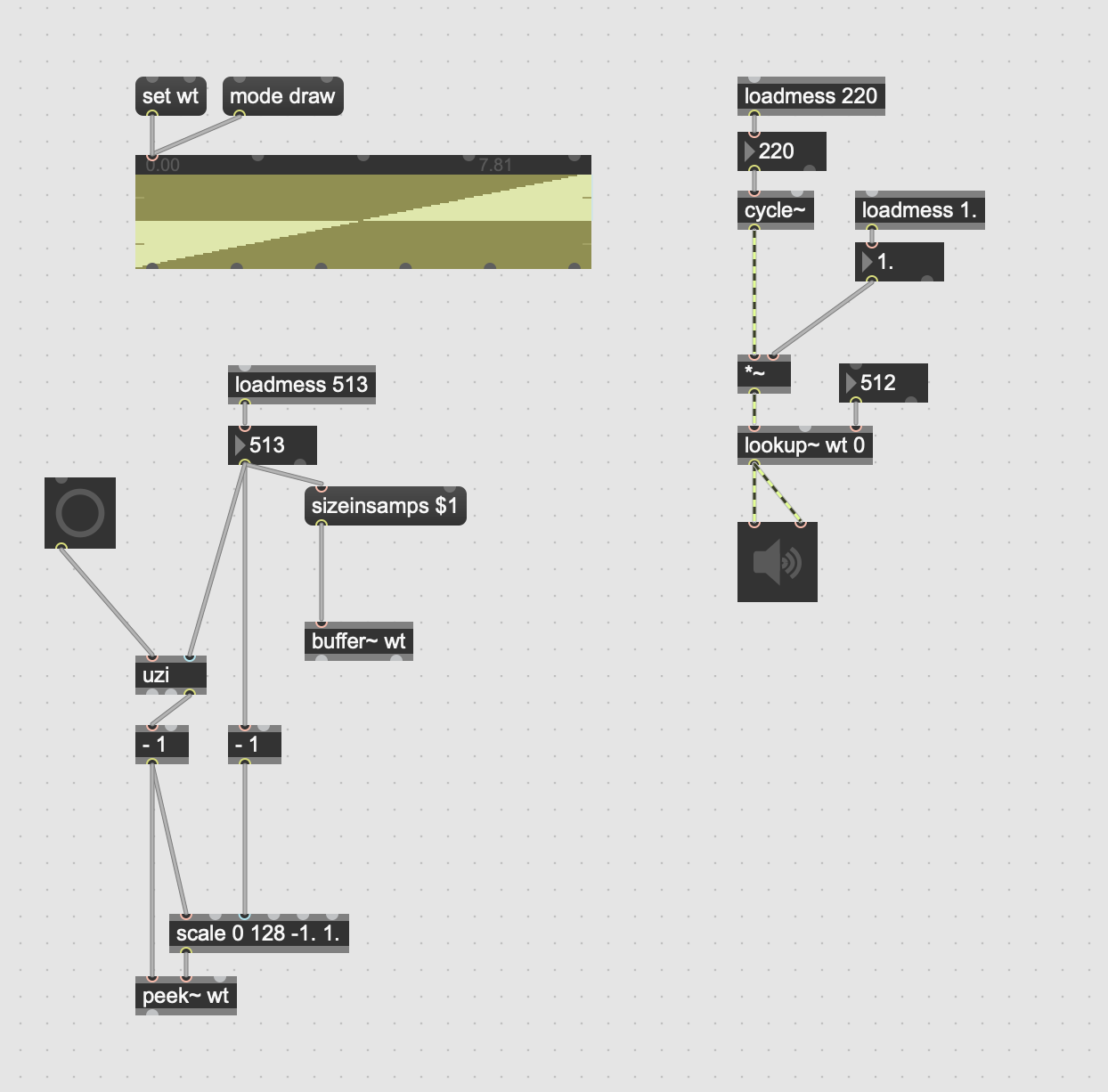
More details here, after some follow up investigations.
If in my example, if the buffer~ wt is set to an odd number (511, 513, 515), I can use the same number as the size of the lookup table. If it is even, I need to decrease the lookup table size by 1. In these cases I don't hear sidebands when I leave the amplitude of the input signal at 1.
Any thoughts or explanations on this?
Is this a bug?

it's probably by design: odd numbered table-sizes allow for the 'scaling'/'ranging' of an indexing 'phase'(between -1 and 1), to observe a true middle-point of the wavetable(at phase: 0.), otherwise, if you attempt to range an even numbered table size between -1 and 1(for phase), but still want the exact middle of the wavetable to be indexed by a phase of '0.', you'll hit a sample-number which is not an integer when using even-numbered table-sizes.
this is good to review interface and sound wise: when you think about the sound, it's best if, while the input signal is silent, the part of the wavetable accessed is a sample which is also silence.
with a bipolar waveform that forms a complete cycle, the middle of the waveform should be the 0-crossing point = silence.
the bipolar lobes of the waveform that extend out from either side of this 0-crossing point should then be equal in size on both ends = odd-numbered wavetable-size.
tl;dr - the bipolar phase we use to index/read the wavetable requires an odd-numbered wavetable size to find a proper/exact middle-point sample(i.e. find an exact integer address when indexed by 'phase of 0').
Thank you for your answer, but I am not completely convinced... The output gets interpolated, so in theory there should also be a 0 at the middle in this case, even with a buffer of even samples. Is this documented anywhere, if it is by design?