
FFT in RNBO

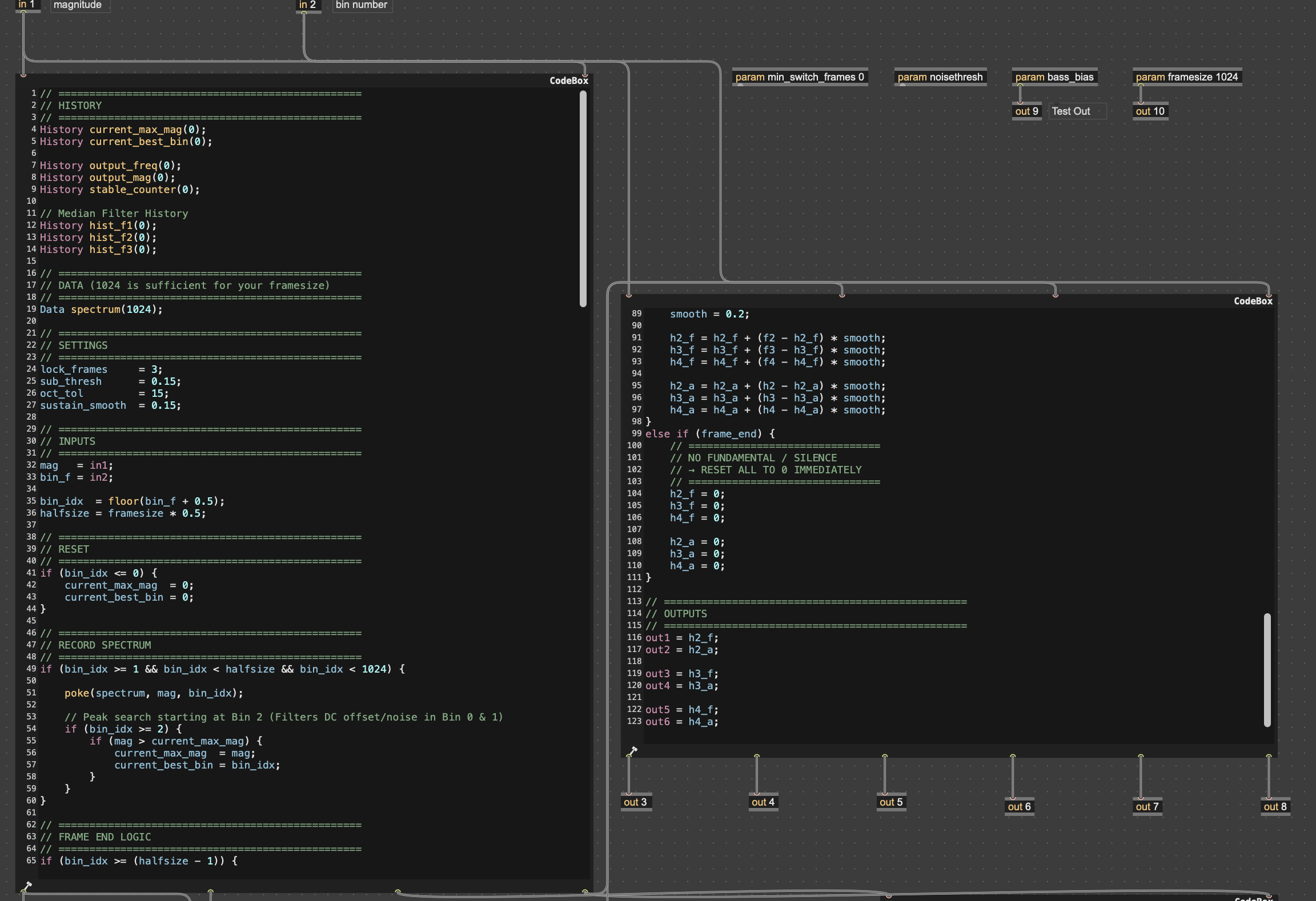
Hi everyone! I’ve been working on extending the classic FFT7 tutorial patch from the C74 docs and turning it into something more robust and RNBO-ready. The repository contains two versions: Version 1 – optimized for speed and transient response. Version 2 (v1.7) – a major rewrite where the entire logic lives inside gen~. With v1.7, my main focus was improving how the tracker reacts to monophonic signals (e.g. voice, guitar, synth). The goal was to achieve more stable tracking, reduce jitter/small frequency fluctuations, and get a generally calmer response. I’d really appreciate it if anyone has time to take a look at the code! I’m especially interested in feedback on the overall approach or anything that could be improved. https://github.com/voxuser1/A-Tom-Soundware-Developer-s-Patch-Collection/tree/main/FFT%20Tracker

Very interesting project!
I've been getting really high quality results from doing analyses with this one: https://github.com/jundsp/Fast-Partial-Tracking. It runs in Matlab and/or (with minor adjustments) Octave. There are Python and C++ versions over here: https://github.com/BJCOLAS/fast-partial-tracking.
It would be fantastic to have this in rnbo,
cheers
Thanks! I’ll look into it.
I’ve pushed a new experimental version v1.8.1 to GitHub.
This update significantly improves stability and now supports 4-voice polyphony much more reliably.
Key changes:
– Anti-Ghosting: Voices are no longer simply muted when they appear too close to a stronger neighbor. Instead, the algorithm shifts subsequent voices up to keep all available slots active.
– Bass Bias: Added gentle spectral weighting to favor fundamentals over higher harmonics, reducing octave jumping and jitter.
Feedback is very welcome, especially from people working with FFT or gen~ in RNBO.